
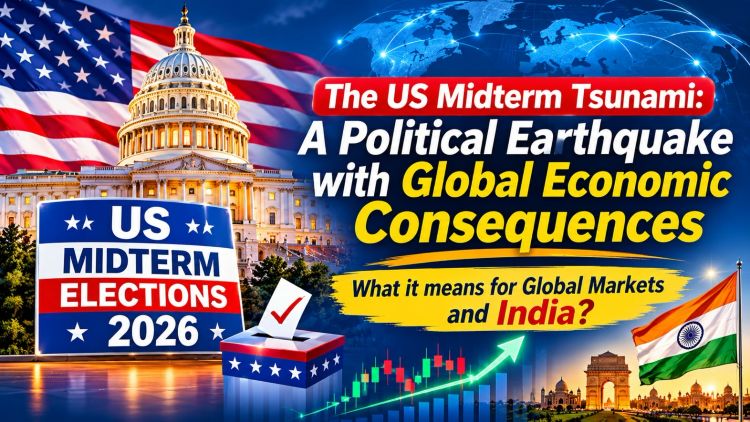
The United States has witnessed a remarkable political realignment following the November 3, 2026, midterm elections. What was expected to be a routine electoral assessment of the ruling party has turned into a significant political setback for President Donald Trump, with Democrats capturing control of both the House of Representatives and the Senate.
This development represents much more than a change in congressional arithmetic. It signals the beginning of a new phase of political negotiations, institutional checks and uncertainty surrounding the direction of American economic policy.
For global markets, the implications could extend well beyond Washington, influencing international trade, currencies, interest rates, commodities, investment flows and economic relationships. For India, the developments deserve particular attention given the importance of its economic partnership with the United States.
1. A Political Tsunami in Washington
The 2026 US midterm elections emerged as an important referendum on the performance of the Trump administration.
Several issues contributed to the Republican setback, including:
– Rising cost of living and household financial pressures.
– Inflation and concerns over purchasing power.
– Trade tariffs and their economic consequences.
– The Iran conflict and geopolitical uncertainty.
– Broader concerns about the economic environment.
Democrats achieved significant gains in traditionally Republican constituencies, demonstrating how quickly political loyalties can shift when household economic concerns become dominant.
The election outcome creates a divided government for the remaining two years of President Trump’s term. While Trump continues as President, Democratic control of Congress gives the opposition greater influence over legislation, government spending, investigations and presidential appointments.
This political arrangement could make policymaking more complicated and increase uncertainty around major economic decisions.
2. What Changes in US Economic Policy?
The election outcome could influence several important areas of American economic policy.
A. Taxation and Fiscal Policy
The Trump administration may find it more difficult to secure congressional support for additional tax legislation and major spending proposals.
Negotiations surrounding the federal budget, government borrowing and fiscal priorities could become more complicated.
For investors, the key question will be whether political disagreements affect government spending plans, fiscal discipline and the overall US deficit trajectory.
B. Trade Policy and Tariffs
President Trump’s tariff policy is likely to face greater political and legislative scrutiny.
However, it is important to understand that the President retains significant executive powers over international trade. A Democratic victory in Congress does not automatically mean that existing tariffs will be withdrawn.
For global businesses, the direction of US trade policy will remain an important consideration.
For India, this distinction is particularly significant because the future of India-US trade relations, export competitiveness and supply-chain cooperation could influence several domestic industries.
C. Federal Reserve and Interest Rates
The Federal Reserve remains institutionally independent of the US government.
However, fiscal policy, government borrowing, inflation and economic growth can all influence the broader interest-rate environment.
Investors should therefore monitor:
– US Treasury bond yields.
– The US Dollar Index.
– Inflation trends.
– Federal Reserve policy decisions.
– Government borrowing requirements.
It would be premature to assume that the election outcome will automatically lead to interest-rate cuts.
The Federal Reserve’s decisions will continue to depend primarily on economic data and its assessment of inflation and employment conditions.
D. Geopolitical Developments
Congressional oversight of the administration’s foreign policy may increase following the election.
Issues such as the Iran conflict, international security, US-China relations and global trade could become subjects of greater political debate.
These developments matter because geopolitical uncertainty can influence several global economic indicators, including:
– International crude oil prices.
– Global shipping and transportation costs.
– Gold prices.
– Commodity markets.
– International investment sentiment.
Any escalation in geopolitical tensions could create additional uncertainty for businesses and investors worldwide.
3. Implications for India: What Should We Watch?
The United States remains one of India’s important economic partners. Changes in American trade, technology, immigration and investment policies can have consequences for Indian businesses and financial markets.
The following sectors and economic indicators deserve particular attention.
Indian IT and Technology Exports
Indian IT companies have significant business exposure to the US market.
Any changes in American technology spending, immigration policies, corporate investment or outsourcing demand could influence the growth prospects of Indian IT businesses.
Pharmaceutical and Engineering Exports
India’s pharmaceutical and engineering industries also have important international trade connections.
Changes in tariffs, import regulations and bilateral trade negotiations could influence their competitiveness and export opportunities.
India-US Trade Negotiations
The future direction of bilateral trade negotiations will be important for Indian exporters and manufacturers.
Greater clarity on tariffs, market access and trade cooperation could support business confidence.
US Investment in Indian Manufacturing
Global companies continue to evaluate supply-chain diversification and manufacturing opportunities.
India’s ability to strengthen its manufacturing ecosystem and attract international investment will remain important in this changing global environment.
Foreign Portfolio Investment (FPI)
International political and economic developments can influence foreign investors’ allocation decisions.
A weaker US dollar and lower US bond yields could support capital flows towards emerging markets, including India.
However, geopolitical uncertainty, trade tensions and changing global risk appetite could offset these potential benefits.
Dollar-Rupee Movements
Currency movements will also be an important factor to monitor.
Changes in the US dollar, global interest rates, crude oil prices and foreign investment flows can influence the Indian rupee.
For Indian businesses with significant import or export exposure, currency movements can have a direct impact on costs, revenues and profitability.
4. What Should Investors Watch?
For investors, the most important approach is to look beyond political headlines and focus on the economic indicators that influence financial markets.
The following six factors deserve close attention:
1. US Inflation and Employment Data
Inflation and employment figures will remain critical indicators of the strength of the American economy and the Federal Reserve’s future policy decisions.
2. US Treasury Bond Yields and the Dollar Index
These indicators provide valuable insights into global liquidity conditions, interest-rate expectations and international capital movements.
3. Federal Reserve Interest-Rate Decisions
Changes in US monetary policy can influence borrowing costs, currency movements and investment flows across global markets.
4. Government Deficit and Borrowing Requirements
The US government’s fiscal position and borrowing requirements could influence bond yields and broader financial conditions.
5. Trade Policy and Tariff Developments
Changes in trade regulations and tariff policies may affect global supply chains, corporate costs and export-oriented industries.
6. Corporate Earnings
Investors should closely monitor corporate earnings, particularly in the technology and manufacturing sectors, as these provide important insights into actual business performance.
Ultimately, the impact on equity markets will depend on economic fundamentals rather than the election outcome alone.
5. My Economic Assessment: Looking Beyond Political Headlines
The 2026 US midterm elections demonstrate that political power is closely linked to economic expectations and household financial conditions.
For President Trump, the remaining two years will require greater negotiation with Congress. For global investors, the period ahead may bring uncertainty surrounding taxation, trade and geopolitical priorities.
For India, the right approach is to maintain strategic economic engagement with the United States while diversifying trade relationships and strengthening domestic manufacturing capabilities.
The larger message is that political uncertainty in the world’s largest economy does not remain confined to Washington. It travels through currencies, interest rates, trade, commodities and international capital markets.
The next phase of the global economy will therefore require investors to look beyond political headlines and focus on inflation, earnings, liquidity and long-term economic fundamentals.
Political power may change through elections, but economic consequences travel across borders.
About the Author
Trinath Lenka
Economist | Managing Director, Wallet4Wealth
At Wallet4Wealth, our focus is on understanding economic developments, identifying their potential implications and helping investors look beyond short-term market movements through informed financial perspectives.
To receive your copy of FREE eBook on Financial Freedom Subscribe Here This blog is purely for educational purposes. Mutual fund investments are subject to market risks, read all scheme-related documents carefully.


